

READ/LISTEN ONLINE:
SOME STUDY GEMS:

Click on the gem below to read the study notes:
Brazen Serpent
2Kings 18:4 He removed the high places, and brake the images, and cut down the groves, and brake in pieces the brasen serpent that Moses had made: for unto those days the children of Israel did burn incense to it: and he called it Nehushtan.
The name Nehustan H5180 – nᵊḥuštān literally just means “a thing of brass”. It is said that Hezekiah named it “Nehushtan” to remind people that it was only a piece of brass. This image, which many so easily love and believe in, had no power in it. Even in the Numbers 21 incident, it was YHWH who does the healing, not Nehushtan.
Yeshua referenced the bronze serpent in John 3:14, “As Moses lifted up the serpent in the wilderness, so must the Son of Man be lifted up.” A reminder that Yeshua is the Salvation, not the wooden cross.
Interestingly, snake cults had been well established in Canaan going back to even Abrahams’ time. Archaeologists have uncovered serpent cult objects in several pre-Israelite cities in and around Canaan, even in Babylon, where pairs of bronze serpents were erected beside each entrance to the temple. The use of pairs of bronze serpents as part of temple architecture or as symbols with a healing or protective significance appears to have roots in ancient Mesopotamia.
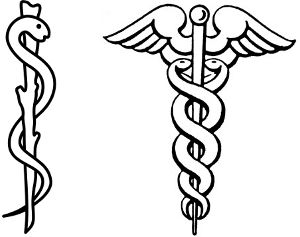
The caduceus, a symbol consisting of a staff with two entwined snakes and wings at the top, is traditionally associated with the Greek god Hermes (or Mercury in Roman mythology). The word caduceus itself means “herald”, to make proclamations or carry official messages. It’s a “herald’s wand,” a staff carried by messengers and heralds to signify peaceful intentions. While the caduceus has been mistakenly adopted as a medical symbol, its true origin lies in its association with diplomacy, commerce, and the messenger “god”.
This should once again be a reminder, that our healing doesn’t come from medicine, but from YHWH. Do not be fooled by the “healing snake“, sending a message of “peaceful intentions“.
Isaiah
2 Kings 19:1-2 “And so it was, when King Hezekiah heard it, that he tore his clothes, covered himself with sackcloth, and went into the house of YHWH. Then he sent Eliakim, who was over the household, Shebna the scribe, and the elders of the priests, covered with sackcloth, to Isaiah the prophet, the son of Amoz.”
Isaiah is first mentioned in the Book of Kings in 2 Kings 18:1-20, and then another three times in 2 Chronicles. This section chronicles the reign of King Hezekiah and includes accounts of Isaiah’s prophecy and influence on the king. The book of 2 Kings also mentions Isaiah in relation to other kings of Judah, including Uzziah, Jotham, and Ahaz, during whose reigns Isaiah prophesied. Of all the prophets, Isaiah had the closest relationship to royalty and his activities and influence were at their peak during the reign of King Hezekiah.
This story of Judah’s rescue in 2 Kings 18-19, can also be read in Isaiah 36-37. These chapters describe the Assyrian army’s siege of Jerusalem and Hezekiah’s response, including his prayer to YHWH for deliverance. The miraculous destruction of the Assyrian army is attributed to YHWH’s intervention, following Hezekiah’s prayer.
Judah rescued, Hezekiah
Hezekiahs‘ name in Hebrew is H2396 – ḥizqîyâ meaning “YHWH is my strength“, coming from two words: H3050 – yâ (YAH) and HAZAK H2388 – ḥāzaq, meaning strong, repair, hold, hard and even courage.
Hezekiah, the son of the wicked King Ahaz, reigned over the southern kingdom of Judah for twenty-nine years, from c. 715 to 686 BC. King Hezekiah was a ruler of Judah considered highly righteous and faithful to YHWH. He is praised for his spiritual leadership, his commitment to YHWH’s worship, and his devotion to following YHWH’s commandments. Hezekiah’s actions and dedication to YHWH’s teachings led to a revival in Judah and a restoration of the temple. Hezekiah’s story is told in 2 Kings 16:20—20:21; 2 Chronicles 28:27—32:33; and Isaiah 36:1—39:8. He is also mentioned in Proverbs 25:1; Isaiah 1:1; Jeremiah 15:4; 26:18–19; Hosea 1:1; and Micah 1:1.
In 701 BC, Hezekiah and all of Judah faced a crisis. The Assyrians, the dominant world power at the time, invaded Judah and marched against Jerusalem. The Assyrians had already conquered the northern kingdom of Israel and many other nations, and now they threatened Judah, the Southern Kingdom. In their threats against the city of Jerusalem, the Assyrians openly defied the YHWH, likening Him to the powerless gods of the nations they had conquered.
Faced with the Assyrian threat, Hezekiah sent word to the prophet Isaiah (2 Kings 19:2). In the temple, Hezekiah prays a beautiful prayer for help, asking YHWH to vindicate Himself: “Now, YHWH Elohim, deliver us from his hand, so that all the kingdoms of the earth may know that you alone, YHWH, are Elohim” (2 Kings 19:19). That night the angel of YHWH went out and put to death a hundred and eighty-five thousand in the Assyrian camp.
Nineveh, the Assyrian's Capital
2 Kings 19:36 So Sennacherib king of Assyria departed and went away, returned home, and remained at Nineveh.
In the mid-19th Century three ancient Assyrian cities – Nineveh (on the outskirts of modern-day Mosul), Nimrud and Khorsabad were discovered and excavated, and a treasure trove of historical sources were unearthed. Here in 2 Kings, Nineveh, the capital of the Assyrian Empire, is mentioned primarily in the context of Assyria’s power and its eventual destruction. 2 Kings 19:36 is repeated in Isaiah 37:37. Nineveh is first mentioned in Genesis 10:8-12, where Nimrod “went to Assyria and built Nineveh”.
Later in Scripture, one of the smaller prophets, the book of Nahum is dedicated to foretelling the destruction of Nineveh, starting with Nahum 1:1 “The burden against Nineveh. The book of the vision of Nahum the Elkoshite.” Nineveh was a powerful and feared city, a symbol of Assyrian might. The prophets, including Jonah and Nahum, prophesied against Nineveh’s wickedness and predicted its downfall. Jonah was initially sent to preach repentance to its people. The people of Nineveh eventually repent, and YHWH spares them, but then later in the book of Nahum, Nineveh is destroyed and described as a “city of bloodshed“.
