

Jubilee
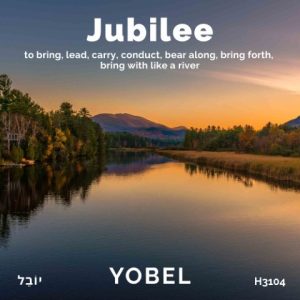
Leviticus 25 is about the Jubilee. The Hebrew word for Jubilee is very interesting – it is YOBEL H3104 – yôḇēl. The root word is Yabal (H2986 – yāḇal) which means to bring forth, to lead, carry, conduct, bear along. The exact same word, just pronounced differently is Yubal (H3105 – yûḇāl) meaning a stream, like a river. So the word now becomes more clear on its meaning. It is the moment, the appointed time to BRING FORTH.
Our translators sometimes translate the “Jubilee” as “rams horn” – which is NOT CORRECT and can be confusing, especially when reading in english. This translation error is done in Joshua 6 – where the conquest of Jericho is happening. During this procession they are indeed blowing the Shofars (Sopar H7782), but it also mentions they do this during Yobel (Jubilee).
SABBATICAL YEARS (Every 7 years):
We read in Leviticus 26 with the curses (verse 43), it says if the people are taken captive and the land is abandoned, that the land will still enjoy the Sabbaths/Sabbatical Years. In another case, 2 Chronicles 36:21, it talks about the 70 year exile of Israel to Babylon, “in order to fill the word of YHWH by the mouth of Jeremiah, until the land had enjoyed her Sabbaths. As long as she lay waste she kept Sabbath, until seventy years were completed.”
Every 7 years is called the Sabbatical Year – where the land also stops working and takes “a rest”. This is the year to trush YHWH for His provision. So when the Isrealites entered the Promised Land, they will count every 7 years : 0 (when they enter the land they have not yet worked on it, so they cannot harvest yet), 7, 14, 21, 28, 35, 49 (that is 7 times they have counted every 7 years – 7 x 7 = 49). The 50th year marks an extra special year -> Jubilee / Yobel / Bringing forth.
WHAT IS A JUBILEE YEAR?
In Leviticus 25 verses 8-10 it says to count to the 49 years. In the 49th year, on the Day of Atonement (Yom Kippur), which is the 10th day of the 7th biblical month, to announce the 50th year coming up – which is called the Jubilee Year. The Day of Atonement a special day for payment of sins and to proclaim release (freedom from debt/owe) to everyone living in the land. Then the 50th year is set apart and is a Jubilee Year. It is like a “mega Sabbath” focused on liberation, rest, and restoring social justice. It includes forgiving all debts, freeing enslaved Israelites, returning ancestral land to its original owners, and allowing the land to lie fallow.
Redeemer
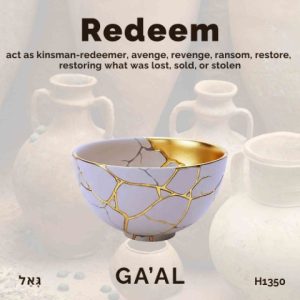
In Leviticus 25:25 the word REDEEM is mentioned 3 times, “When your brother becomes poor, and has sold some of his possession, and his redeemer, a close relative comes to redeem it, then he shall redeem what his brother sold.”
The word REDEEM in Hebrew is GA’AL H1350 – gā’al, to deliver, a revenger, a redeemer. In this translation it mentions a “close relative”, and it might be in your translation too, but it is NOT in the original Hebrew. Rather it is someone close to you, and brother could be same tribe, not necessarily family.
This word Redeem is mentioned a lot in Lev 25, 27, Joshua, Ruth (where Boaz is her redeemer), Psalms, and Isaiah 43-47 “Do not fear, for I have redeemed you. I have called you by your name, you are Mine…. Thus said YHWH, Sovereign of Yisrael, and his Redeemer, YHWH of hosts, ‘I am the First and I am the Last, besides Me there is no Elohim. …I shall wipe out your transgressions like a cloud, and your sins like a mist. Return to Me, for I shall redeem you….”
Dedicating someone

Leviticus 27 talks about dedicating a child, or someone, or something to YHWH with an oath/vow. When you are making an oath to give this person/animal/house/land to YHWH, but you cannot physically give him/it or offer him/it, you give a certain amount in silver worth to finalize the oath you are making.
When you do want to make a vow to YHWH, make sure to be very clear on what oath you are making. Deuteronomy 23:22 says “When you make a vow to YHWH your Elohim, do not delay to pay it, for YHWH your Elohim is certainly requiring it of you, and it shall be sin in you. But when you abstain from vowing, it is not sin in you. That which has gone from your lips you shall guard and do, for you voluntarily vowed to YHWH your Elohim what you have promised with your mouth.”
In Judges 11 we have the story of Yiphtaḥ making a vow very quickly to YHWH and not being very specific, and he was very sorry about it. Verse 35 “I have given my word to YHWH, and I am unable to turn back”. Ecclesiastes 5:2 says “Do not be hasty with your mouth, and let not your heart hurry to bring forth a word before Elohim. For Elohim is in the heavens, and you on earth, therefore let your words be few.” And verse 4-5 “When you make a vow to Elohim, do not delay to pay it, for He takes no pleasure in fools. Pay that which you have vowed. It is better not to vow than to vow and not pay.”
Today we have a tradition where we dedicate our children to YHWH, which is a beautiful thing. But with our dedications, we are making some kind of promise or vow for that child, and we have to remember our promises and keep our side of the bargain.
We use the word Dedicate, but the Hebrew word used in this Scripture is QADOSH H6942 – qāḏaš, which means to be set-apart. To be different, everyone will know and recognize there is something different about this person or land or animal – it is not like the rest.
Tithes
Leviticus 27 says this about Tithes:
30 ‘And all the tithe of the land – of the seed of the land or of the fruit of the tree – belongs to YHWH. It is set-apart to YHWH.
31 ‘If a man indeed redeems any of his tithes, he adds one-fifth to it.
32 ‘And the entire tithe of the herd and of the flock, all that passes under the rod, the tenth one is set-apart to YHWH.
For tithes given in the sense of money, it was allowed to redeem an animal or harvest by adding another 20% in monetary value and giving it to the Levites. Later in Scripture we will see other ways of how to give or use a tithe. In certain cases, the tithes are given to the Levites, as they were not allowed to own any land or have any other income – this was how they were taken care of. In other cases, the tithes are given back to the person to enjoy themselves for the Feasts. And then in another case the tithes are gathered every 3 years in one place, where all who are needy could come and be helped. (Deuteronomy 14)
