
READ/LISTEN ONLINE:
SOME STUDY GEMS:

Click on the gem below to read the study notes:
7 Spirits, 7 Lampstands and 7 Stars
Revelation 1:4 “Grace to you and peace from Him who is and who was and who is to come, and from the seven Spirits who are before His throne“
In Isaiah 11 we also had a vision of the seven Spirits, and each were given a type or form, Wisdom, Understanding, Might, etc – click here to read more on that post. In Revelation 3:1 we also read, “These things says He who has the seven Spirits of God and the seven stars“. These seven stars were also mentioned in Rev 1:16, “He had in His right hand seven stars” and verse 20, “The mystery of the seven stars which you saw in My right hand, and the seven golden lampstands: The seven stars are the angels of the seven churches, and the seven lampstands which you saw are the seven churches.”
Lampstands – 7 Assemblies (G1577 – ekklēsia) See our previous from Acts 20 about the true meaning of “church”.
Stars – 7 Angels (See our previous posts on Angels and Stars)
The Seven Assemblies (churches and buildings)
Revelation 2:1 “To the angel of the church…”
In our previous post from Acts 20 we explained the origin of the word “church”, which has more to do with buildings today, and a completely different meaning in Scripture. If we would translate church back to greek, the word is actually Kuriakon G2960 – kyriakos, hence the word (in different languages) : kerk/kirk/kyrka/church. This word is only mentioned twice in Scripture, and has nothing to do with “a church”. The original greek word used here in Scripture is G1577 – ekklēsia, which means “an assembly” of people, people coming together. This greek word is used a lot in Scripture and translated to “church”, which should actually be “the assembly of people”.
The 7 churches of Revelation, which are located in Turkey, have been made a big tourist attraction, where people think they will see the remains of the churches/buildings. (I myself have been on those tours), and all there really is, is ancient ruins of the city itself. One have to realize, the people back then didn’t have big “church” buildings or the funds for it. The churches mentioned in the Book of Revelation were communities of believers who gathered primarily in private homes, not in dedicated church buildings as we know them today. This was the standard practice for early Christians during the first century AD. Christianity was often an illegal or marginalized religion in the Roman Empire during the first two centuries, so followers did not construct large, public places of worship. The first purpose-built church building for which archaeological evidence exists is the Dura-Europos church in Syria, which was a converted house dating to around AD 233-256. Dedicated church buildings did not become the norm until the 4th century, after Emperor Constantine legalized Christianity.
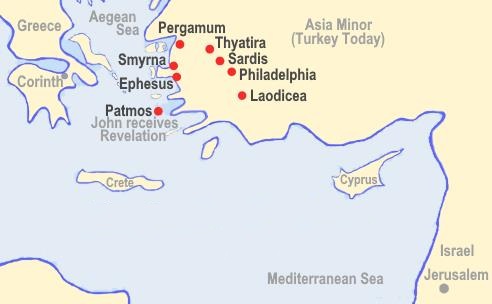
One have to wonder what was so special about these 7 assemblies/groups of believers placed between Europe and Israel, as there were many other assemblies all over these countries, including Israel itself, even towards Egypt and China. These 7 churches were special, because they were in the heart of the beasts’ belly, and they were enduring incredible suffering and persecution. A very dark period was coming, earthquakes, wars and the dark ages – and these 7 churches were pointed out and given encouragement to stand strong, and know there will be a reward. Surviving persecutions and standing strong, as Yeshua says, “he who overcomes” will:
- 2:7 – Allowed access to the Paradise, and the Tree of Life
- 2:11 – Will not experience the second death (which is the spiritual death)
- 2:17 – Be given manna (angels’ food) to eat, and receive a white stone with a new name
- 2:26-28 – Will rule with Yeshua over the nations
- 3:5 – Be given new clothes, white garments
- 3:12 – Be part of the Temple in the New Jerusalem
- 3:21 – Will sit with Yeshua
Here is a quick summary of each of these cities:
Ephesus – a major earthquake in 262 AD devastated Ephesus and other cities along the western and southern coasts of Anatolia, causing a tsunami. The Temple of Diana (to the Romans) / Temple of Artemis (to the Greeks) were located in Ephesus and was one of the seven wonders of the world. It had 127 pillars that were 60 feet tall. Diana (or Artemis) was the goddess of fertility and was worshipped with immoral sexual activities. Ephesus was a stronghold for Satan and many superstitious and satanic practices. It held a great library that was filled with books on sorcery, forbidden arts, and practices of the occult.
Smyrna – This city has a long history, and was never destroyed – it even made it through the dark ages, and still exists today as the modern city of Izmir. Orthodox Christianity in Smyrna ended as a result of the Greco-Turkish War of 1919–1922. In September 1922, during the events of the Great Fire of Smyrna, thousands of civilians lost their lives and the survivors found refuge to Greece. It is estimated that of a total of 459 priests and bishops of the metropolis of Smyrna, 347 of them were murdered by the Turkish army. Smyrna had a golden street which ran from the sea up to Mount Pagos. Along the road were many pagan temples to the nature goddess (Cybele), the sun god (Apollo), the healing god (Asclepius), the goddess of love and beauty (Aphrodite), and Zeus the head deity.
Pergamos – the city was badly damaged in an earthquake in 262 and was sacked by the Goths shortly thereafter. was the capital city of the province of Asia and the site for the famous temple to Asclepios, the god of healing. It had temples to Greek and Roman gods Dionysus, Athena, Demeter, Zeus and three temples to the Roman Emperor. Yeshua looked upon Pergamos as Satan’s throne. The temple where the people worshipped had an image of the god of healing with a serpent wrapped around his staff. It had a huge throne-like altar that was dedicated to the Roman god Zeus. The believers in Pergamos faced severe persecution and many were martyred for their faith.
Thyatira – In 366 AD, a significant battle was fought near Thyatira which gave the city it’s biggest blow. The city was situated in an exposed, long valley and lacked natural defenses, making it vulnerable to military attacks throughout its history. The ancient city of Thyatira primarily worshipped the god Apollo Tyrimnaeus, a local deity often identified with the Greek sun god Apollo. Other gods and goddesses were also worshipped, and several temples or shrines existed in the city.
Sardis – this cities’ final destruction came during the Medieval/dark-ages periods through many wars. The most significant worship site was the monumental Temple of Artemis, one of the largest in the ancient world. An equivalent of Zeus was worshipped, and early Lydian coins featured his image. After Alexander the Great conquered the city in 334 BCE, he ordered the building of a temple to Zeus.
Philadelphia – The ancient city of Philadelphia (modern-day Amman) was destroyed by a powerful earthquake in 363 AD. This city primarily worshipped Dionysus, the god of wine, due to the region’s fertile vineyards. The city was also known as “little Athens” because of its many temples dedicated to a variety of other gods and goddesses.
Laodicea – the great shock that occurred in the reign of Nero (60 AD) in which the town was completely destroyed. It was struck again in 494 AD, and again in the early 7th Century, where the event was so severe that the city was subsequently abandoned by most of its inhabitants. Laodicea was a wealthy city with thriving textile industry, banks and medical school. But the people became spiritually complacent because of their self-sufficiency. Somewhere around 361 A.D. almost no Christians were to be found in Laodicea. As the supreme god, Zeus had a prominent place in the city’s religious life, and the city was originally named Diospolis (“City of Zeus”).
The major persecutions the followers faced was because it was demanded the worshipping of the emperor as a god, they believed in many gods for the sexual pleasures and financial welfare. For the world these cities were the leaders and frontiers of welfare, with their world famous buildings and attractions. Today, we certainly have those again – world leading cities, where the heart of living is about sexual pleasures, drinking, financial gain and climbing the success ladders.
